

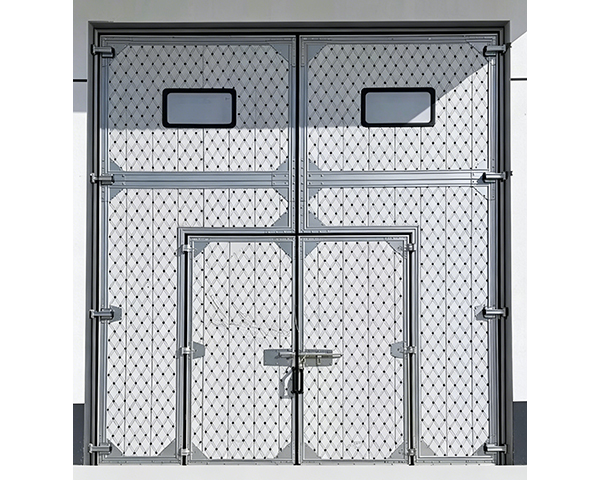
A fireproof and high temperature resistant industrial door is a specialized safety door system designed to prevent the spread of fire, resist extreme heat, and protect industrial facilities, personnel, and equipment during fire emergencies. It is widely used in factories, warehouses, power plants, logistics centers, underground facilities, parking structures, and high-risk industrial environments where fire safety is a critical requirement.
With increasing global safety standards and stricter building fire codes, fire-resistant industrial doors have become an essential part of modern industrial infrastructure. These doors are engineered using fire-resistant materials and reinforced structural designs to maintain integrity under high-temperature conditions while providing reliable compartmentalization during fire incidents.
The core function of a fireproof industrial door is to delay fire spread and maintain structural stability during high-temperature exposure.
Fire resistance ratings typically include:
60 minutes fire rating
90 minutes fire rating
120 minutes fire rating
Customized higher ratings for special projects
The door structure is designed to withstand high temperatures while preventing flame penetration.
These industrial doors are engineered to operate under extreme heat conditions using advanced materials such as:
Fire-rated steel panels
Calcium silicate fire boards
Rock wool insulation core
Intumescent sealing strips
These materials expand or insulate under heat, improving fire containment performance.
Fireproof and high temperature resistant industrial doors are built with reinforced steel frames to ensure stability under thermal stress.
Key advantages include:
High deformation resistance
Reinforced hinge and track systems
Anti-collapse structural design
Long-term durability
In fire emergencies, smoke is often more dangerous than flames. These doors are equipped with sealing systems that prevent smoke leakage.
Features include:
Intumescent fire seals
Rubber smoke-proof strips
Automatic expansion sealing under heat
The door is designed to automatically close when triggered by a fire alarm system.
Integration options include:
Fire alarm systems
Smoke detectors
Building fire control systems
Emergency shutdown systems
Industrial environments often expose doors to dust, humidity, and chemicals. Fireproof doors are coated with anti-corrosion layers to ensure long service life.
Specifications can be customized according to project requirements and fire safety standards.
| Parameter | Specification |
|---|---|
| Product Type | Fireproof and High Temperature Resistant Industrial Door |
| Fire Rating | 60 / 90 / 120 / 180 minutes |
| Door Material | Fire-rated steel / composite panels |
| Insulation Core | Rock wool / calcium silicate |
| Steel Thickness | 1.0–2.0 mm |
| Maximum Width | Up to 12 m |
| Maximum Height | Up to 10 m |
| Operating Mode | Manual / Automatic / Fire-triggered closing |
| Control System | Fire-linked PLC control |
| Power Supply | 220V / 380V |
| Sealing System | Intumescent + Smoke-proof seals |
| Operating Temperature | -40°C to +800°C (fire exposure resistance) |
| Surface Treatment | Anti-corrosion coating / Powder coating |
| Safety Certification | Fire safety compliant (project dependent) |
The door panel is constructed using multi-layer fire-resistant materials designed to slow heat transfer and maintain structural integrity during fire exposure.
The frame system ensures the door remains stable even under extreme thermal expansion conditions.
Common insulation materials include:
Rock wool
Ceramic fiber boards
Calcium silicate boards
These materials provide excellent thermal resistance and fire containment performance.
The control system enables integration with fire alarm systems and supports:
Automatic closing during fire alerts
Remote monitoring
Manual override
Fault detection
High-performance sealing strips expand under heat to block smoke and flames effectively.
Fireproof industrial doors are widely used in production facilities to isolate fire hazards and protect critical equipment.
Applications include:
Workshop partitions
Chemical storage areas
Equipment rooms
Electrical control rooms
Large warehouses use fire-resistant doors to divide fire zones and protect stored goods.
Benefits:
Fire compartmentalization
Reduced property damage
Improved evacuation safety
High-risk environments such as power stations require strong fire protection systems.
Applications include:
Generator rooms
Transformer stations
Cable tunnels
Fireproof industrial doors help control smoke and fire spread in multi-level parking structures.
Shopping malls, office buildings, and public infrastructure use fireproof doors for stairwells, corridors, and emergency exits.
Facilities storing flammable materials require strict fire separation systems to prevent catastrophic fire spread.
The primary advantage is delaying fire spread and protecting lives and property during emergencies.
The door maintains stability even under high thermal stress conditions.
Effective sealing systems help reduce smoke infiltration, improving evacuation safety.
Helps facilities meet national and international fire safety standards.
Durable steel structure ensures long-term reliability in industrial environments.
Designed for long-term use with minimal maintenance needs.

Before installation:
Confirm fire safety design requirements
Verify opening dimensions
Check wall fire rating compatibility
Prepare electrical fire alarm connections
Install reinforced frame
Mount fire-rated door panels
Install sealing systems
Connect fire control integration
Install safety sensors
Test automatic closing system
After installation:
Test fire alarm linkage
Verify automatic closing
Check sealing performance
Inspect structural stability
Open door via control system
Ensure passage is clear
Complete opening/closing cycle
When fire alarm is triggered:
Door automatically closes
Sealing system activates
Fire compartment is formed
In case of power failure:
Use manual release system
Operate door with mechanical assistance
Restore automatic function after recovery
Check door movement
Inspect seals
Ensure no obstruction
Test fire linkage system
Inspect motor and control unit
Check frame stability
Fire performance testing
Seal replacement if needed
Structural inspection
Electrical system evaluation
It is a specially designed industrial door that prevents fire spread and withstands high temperatures for a defined period.
Depending on configuration, fire resistance can range from 60 minutes to 180 minutes or more.
They are used in warehouses, factories, power plants, underground facilities, and commercial buildings.
Yes, it can automatically close when integrated with fire detection and alarm systems.
Common materials include rock wool, calcium silicate boards, and fire-rated steel panels.
Yes, it is widely used for fire compartmentalization in large warehouse environments.
Yes, regular inspection ensures sealing performance, structural stability, and fire system reliability.
Fireproof and high temperature resistant industrial doors are essential safety components for modern industrial and commercial buildings. With advanced fire-resistant materials, reinforced structural design, intelligent control systems, and reliable sealing technology, these doors provide critical protection against fire hazards.
By limiting fire spread, improving evacuation safety, and protecting valuable assets, fireproof industrial doors play a vital role in industrial risk management and building safety compliance. They are an indispensable solution for warehouses, factories, logistics centers, and high-risk industrial environments requiring dependable fire protection performance.
A fireproof and high temperature resistant industrial door is a specialized safety-oriented industrial access system designed to prevent the spread of fire, resist extreme heat exposure, and protect personnel, equipment, and property during fire-related emergencies or high-temperature industrial processes.
These doors are widely used in manufacturing plants, warehouses, logistics centers, power stations, chemical plants, metallurgy facilities, tunnels, data centers, and commercial-industrial buildings where fire safety compliance and thermal resistance are critical requirements.
Unlike standard industrial doors, fireproof and high temperature resistant industrial doors are engineered using advanced fire-resistant materials, reinforced structural systems, and certified sealing technologies to maintain integrity under extreme conditions.
This comprehensive guide covers definitions, classifications, materials, fire resistance ratings, technical specifications, applications, advantages, installation considerations, and industry trends.
What Is a Fireproof and High Temperature Resistant Industrial Door?
A fireproof and high temperature resistant industrial door is a door system designed to:
Prevent or delay the spread of fire and smoke
Withstand high-temperature exposure
Maintain structural stability under fire conditions
Provide safe evacuation routes
Protect fire zones in industrial buildings
These doors are typically part of a building’s passive fire protection system and are required by many international building codes and fire safety regulations.
Why Fireproof Industrial Doors Are Essential
Industrial environments often contain:
Flammable materials
Electrical equipment
High-energy machinery
Chemical substances
Without proper fire barriers, fire can spread rapidly across facilities, leading to:
Severe property damage
Production downtime
Safety hazards
Loss of life
A fireproof and high temperature resistant industrial door acts as a fire compartment barrier, limiting fire spread and buying critical evacuation and response time.
Fire Resistance Ratings and Standards
Fireproof industrial doors are classified based on how long they can resist fire exposure.
| Rating Class | Fire Resistance Duration | Description |
|---|---|---|
| 30 minutes (EI30) | 30 min | Basic fire compartment control |
| 60 minutes (EI60) | 1 hour | Standard industrial protection |
| 90 minutes (EI90) | 1.5 hours | High protection level |
| 120 minutes (EI120) | 2 hours | Heavy industrial safety |
| 180 minutes (EI180) | 3 hours | Maximum protection systems |
Fireproof industrial doors are commonly designed according to:
EN 1634-1 (Europe fire resistance test)
EN 13501-2 (Fire classification)
UL 10B / UL 10C (USA fire standards)
ASTM E119 (Fire endurance testing)
ISO 3008 (Fire resistance testing)
How Fireproof and High Temperature Resistant Industrial Doors Work
These doors rely on a combination of structural engineering and fire-resistant materials.
The core prevents heat penetration and structural failure.
Common materials include:
| Material | Function |
|---|---|
| Rock Wool | High-temperature insulation |
| Calcium Silicate Board | Fire barrier layer |
| Ceramic Fiber | Extreme heat resistance |
| Gypsum-Based Core | Fire retardation |
| Intumescent Materials | Expands under heat |
Steel layers provide:
Structural stability
Impact resistance
Fire containment support
These seals expand when exposed to heat, blocking:
Smoke
Flames
Toxic gases
Special sealing systems prevent smoke leakage, which is often more dangerous than flames.
Reduces heat transfer to adjacent zones.
Types of Fireproof and High Temperature Resistant Industrial Doors
Sliding fire doors are commonly used in large industrial openings.
Horizontal sliding mechanism
High fire resistance rating
Heavy-duty steel structure
Warehouses
Industrial plants
Storage facilities
Designed for compact installation.
Space-saving
Automatic closure during fire alarm
High durability
Provide both insulation and fire protection.
Thermal efficiency
Structural strength
Controlled operation
Used in extreme industrial environments.
Withstand temperatures above 800°C–1200°C
Specialized refractory materials
Reinforced steel casing
Steel plants
Glass manufacturing
Kilns and furnaces
Integrated with fire alarm systems.
Automatically close during fire detection
Block fire spread zones
Materials Used in Fireproof Industrial Doors
Provides structural support and corrosion resistance.
Used in chemical and high-corrosion environments.
High thermal resistance
Structural stability under fire
| Property | Value |
|---|---|
| Melting Point | >1000°C |
| Fire Resistance | Excellent |
| Thermal Conductivity | Low |
Used in high-temperature industrial applications.
Expand when exposed to heat, sealing gaps automatically.
Technical Specifications
| Parameter | Typical Range |
|---|---|
| Door Width | 1m – 15m |
| Door Height | 2m – 12m |
| Fire Rating | 30 – 180 minutes |
| Steel Thickness | 1.0mm – 3.0mm |
| Core Thickness | 40mm – 150mm |
| Operating Temperature | -40°C to 1200°C (special types) |
| Smoke Leakage Class | S200 / S500 |
| Wind Resistance | Class 5 – Class 12 |
| Closing Speed | Automatic / controlled descent |
| Activation System | Fire alarm integration |
Key Benefits of Fireproof and High Temperature Resistant Industrial Doors
Prevents fire from spreading between zones.
Allows safe evacuation during emergencies.
Minimizes structural damage during fire events.
Reduces toxic smoke movement across building zones.
Meets building safety codes and insurance requirements.
Reduces heat transfer during fire exposure.
Industrial Applications
Protect production zones and machinery.
Divide fire zones and protect stored goods.
Prevent fire spread in hazardous environments.
Protect control rooms and equipment areas.
Used near high-temperature furnaces and processing zones.
Protect critical IT infrastructure from fire damage.
Control fire spread and smoke movement.
Fire Door Operation Systems
Activated by:
Fire alarms
Smoke detectors
Heat sensors
Doors close automatically when power fails.
Allows controlled opening during normal operation.
Manual operation during emergencies.
Safety Features
Prevent toxic gas leakage.
Expand under heat to block openings.
Allow visibility while maintaining fire resistance.
Ensures closure during system failure.
Connected to:
Fire alarm systems
Building control systems
Emergency response systems
Installation Considerations
Walls must support heavy fire door systems.
Doors must align with fire zones.
Proper sealing is critical for fire performance.
Installation must follow:
Fire safety codes
Building regulations
Engineering standards
Maintenance Requirements
Door position
Obstructions
Visible damage
Lubrication
Sensor testing
Seal inspection
Automatic closing function
Alarm integration
Fire resistance integrity
Common Problems and Solutions
| Problem | Cause | Solution |
|---|---|---|
| Door Fails to Close | Sensor fault | Check fire control system |
| Smoke Leakage | Seal damage | Replace intumescent seals |
| Slow Response | Motor issue | Inspect drive system |
| Door Misalignment | Track wear | Adjust rails |
| Excess Heat Transfer | Insulation failure | Replace core material |
Comparison With Standard Industrial Doors
| Feature | Fireproof Industrial Door | Standard Industrial Door |
|---|---|---|
| Fire Resistance | High | None |
| Smoke Protection | Yes | No |
| High Temperature Resistance | Yes | Limited |
| Safety Compliance | Mandatory in many areas | Optional |
| Material Core | Fire-resistant | Standard insulation |
| Cost | Higher | Lower |
| Purpose | Safety protection | General access |
Industry Trends
Integration with:
IoT sensors
Real-time monitoring
AI-based fire detection
Development of:
Nano insulation layers
Lightweight fire-resistant composites
Doors linked with building evacuation systems.
Dual-purpose systems combining:
Fire safety
Thermal insulation
Future Development
Future fireproof industrial doors will include:
Self-diagnosing safety systems
AI-driven fire prediction integration
Ultra-lightweight fire-resistant materials
Enhanced multi-layer composite structures
Faster emergency response mechanisms
Frequently Asked Questions
A fireproof industrial door is a specialized door designed to resist fire and prevent its spread between different building zones.
Depending on classification, they can resist fire from 30 minutes up to 180 minutes or more.
Yes, many industrial and commercial buildings are required by fire safety regulations to install certified fire doors.
Common materials include rock wool, calcium silicate boards, steel panels, ceramic fiber, and intumescent seals.
Yes, many modern fireproof industrial doors are integrated with automatic closing systems connected to fire alarms.
A fireproof and high temperature resistant industrial door is a critical safety infrastructure component in modern industrial and commercial buildings. It provides essential fire containment, smoke control, thermal resistance, and life safety protection.
By combining advanced fire-resistant materials, reinforced steel structures, intelligent control systems, and certified safety standards, these doors significantly reduce fire risk and improve building safety performance.
As industrial facilities become more complex and safety regulations more stringent, fireproof industrial doors will continue to play a vital role in protecting assets, ensuring compliance, and safeguarding human life across all high-risk environments.
เสิ่นหยาง Manlong Metal Products Co., Ltd.


ลิขสิทธิ์ © 2026 Shenyang Manlong Metal Products Co., Ltd. สงวนลิขสิทธิ์ แอปพลิเคชัน
เว็บไซต์นี้ใช้คุกกี้เพื่อให้แน่ใจว่าคุณได้รับประสบการณ์ที่ดีที่สุดบนเว็บไซต์ของเรา

 English
 Español
 Portugues
 Pусский
 Français
 Deutsch
 العربية
 Türk dili
 Tiếng Việt



 โทรศัพท์